
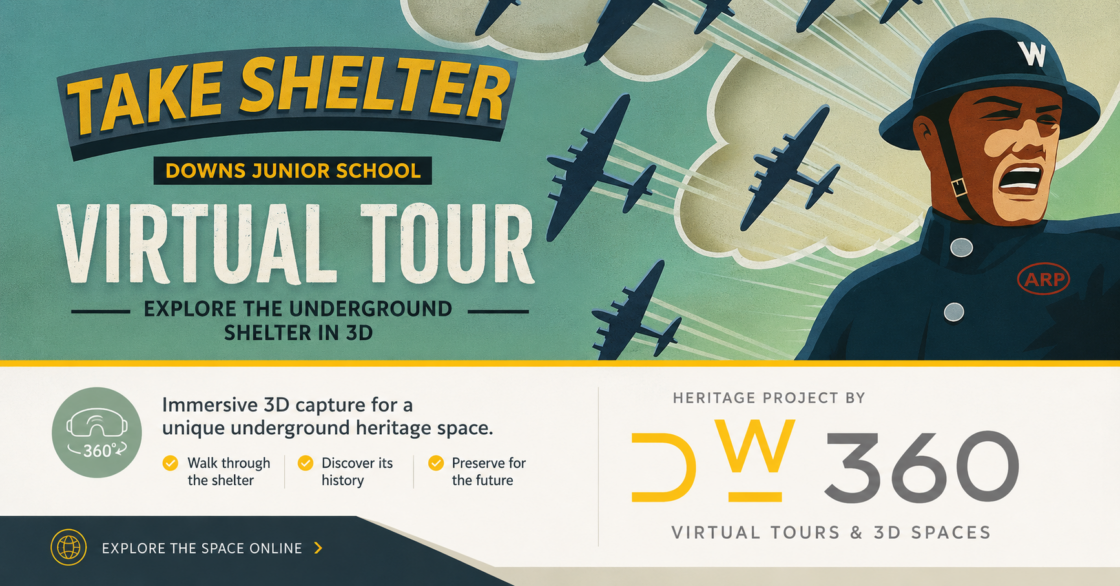
Bringing heritage to life: DW-360 virtual tour project for Take Shelter
DW-360 recently worked with Take Shelter to create an immersive 3D virtual tour of its remarkable underground World War II school air raid shelter in Brighton.
Take Shelter preserves and shares the history of a large underground shelter built to protect 300 children during bombing raids. Today, the space has been transformed into an immersive museum, helping visitors understand an important part of local wartime history.
The aim of the project was not just to create an online walkthrough. It was to produce a practical digital record that could support visitor access, education, outreach and long-term heritage documentation.
A clearer way to understand the space
One of the most useful things about a 3D tour is that it helps people understand a space before they visit it.
In the case of Take Shelter, many visitors expect the shelter to be small, more like a garden Anderson shelter. In reality, the underground space is much larger and was built to protect hundreds of children. The 3D model helps challenge that misconception by showing the real scale, layout and atmosphere of the shelter.
The virtual tour gives viewers a clear sense of the entrance, rooms, route and overall layout. This can be especially useful for people who feel anxious about unfamiliar environments, as they can see what to expect before arriving.
Used online and on-site
The DW-360 virtual tour can be explored online, but it is also being used on-site as part of the visitor experience.
After the shelter was scanned, DW-360 provided a link to the completed 3D model, which Take Shelter has loaded onto a large touchscreen. This means visitors can interact with the space digitally while at the museum, helping them understand the layout and revisit key areas during their visit.
This is where virtual tours can be particularly useful for heritage, museums and public spaces. They can support the physical visit rather than replace it. The digital model gives people a preview, a guide and a record, while the full experience still comes from visiting the shelter in person.
Supporting access, education and outreach
The Take Shelter project shows how 3D capture can help heritage spaces reach wider audiences.
For visitors who cannot easily access the site, the virtual tour opens up the space online. For schools and education groups, it creates a useful visual resource. For the museum team, it provides a long-term digital record of the space as it is today.
The model also creates new opportunities for interpretation. Information points, video, audio and supporting content can be added to help explain rooms, objects and stories within the space.
What DW-360 captured
For this project, DW-360 created a Matterport 3D tour of the underground shelter and museum space. The tour can be embedded into a website, shared by link or QR code, displayed on a touchscreen and used as a long-term visual record.
The project video shows the virtual tour in use, visitors exploring the model on a large touchscreen, and the Matterport capture process inside the shelter.
Video embed: Add the Take Shelter promotional video here.
Virtual tour embed: Add the Take Shelter Matterport tour here.
Bringing heritage to life — one scan at a time
Virtual tours and 3D spaces are often thought of as property marketing tools, but their value goes much further than that.
For heritage sites, museums, schools, venues and public spaces, they can help people understand a place more clearly, improve access, support education and create a useful visual record for the future.
That is the focus of DW-360: practical virtual tours, 3D spaces and digital building records that help people explore, explain and share important spaces.
If you are planning a virtual tour for a heritage site, museum, venue, school or property, you can find out more here:
DW-360 Virtual Tours & 3D Spaces
Or use the shorter project link:
