
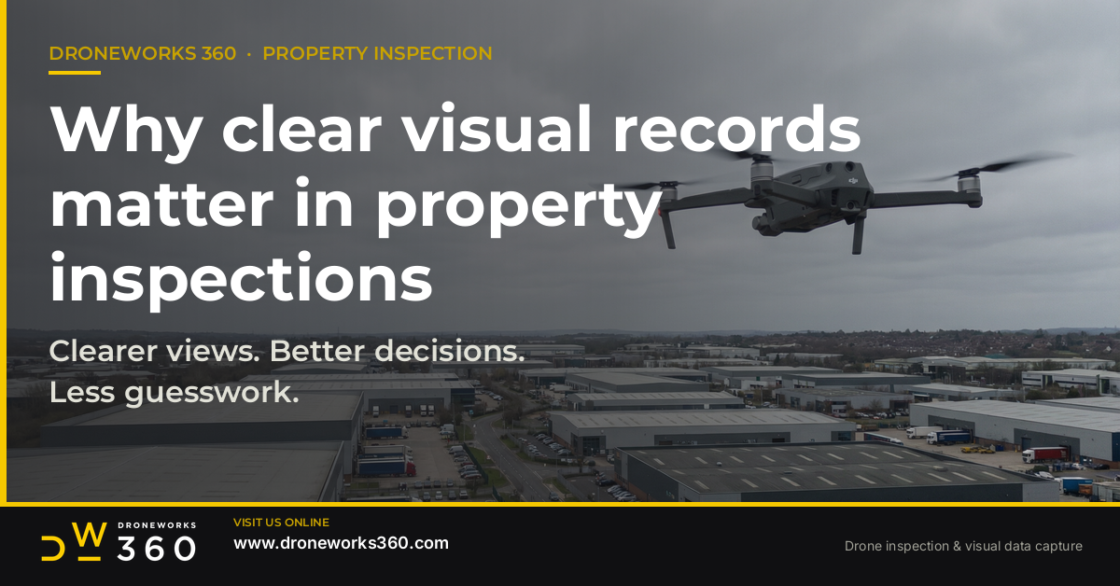
There is a lot of talk around drones, digital twins and visual data at the moment, but for most property professionals the real question is much simpler: does it actually help people make better decisions.
From what we are seeing, the answer is yes, when it is used properly.
At Droneworks 360, most of the value is not in the aircraft itself. It is in what the images, records and visual outputs allow people to do afterwards. A clearer view of a roof. A better record of a church or heritage building. A more useful way for a managing agent, surveyor, contractor or client to look at the same issue without relying on guesswork.
Why visibility still matters
A lot of building problems start in places that are awkward to reach, expensive to access, or simply easy to overlook from the ground.
High-level guttering, parapets, flashings, roof coverings, hidden valleys, drainage points and upper masonry details can all be difficult to assess properly without a closer look. In many cases, by the time a leak, staining or damp issue becomes obvious internally, the original cause has already been there for some time.
That is one reason visual records are becoming more useful. They help move the conversation on from rough assumptions and second-hand descriptions to something much clearer.
Better records lead to better decisions
Drone-based inspection work is useful when it gives people a straightforward and practical way to capture what is actually there.
That does not mean it replaces every traditional method. It does mean it can often improve the starting point.
Instead of relying on memory, limited access or a quick view from the ground, clients and contractors can review real images, compare areas more carefully and discuss the building using the same set of visual information.
That often leads to better decisions around:
- likely causes of defects
- what needs attention first
- what can be monitored
- how follow-on work should be scoped
- how findings are explained to others
- how condition can be reviewed again later
In many situations, that shared understanding is just as valuable as the inspection itself.
Particularly useful on awkward or older buildings
We have seen this most clearly on buildings where access is not straightforward or where details are easier to miss without a high-level view.
That includes older buildings, churches, larger roofs, complex elevations and properties where access equipment would otherwise be needed just to get an initial understanding of the condition.
A clear visual record helps separate urgent issues from non-urgent ones. It also makes it easier to plan repairs, explain priorities and avoid unnecessary confusion between different parties involved in the building.
For clients managing ongoing maintenance, that can save time and reduce back-and-forth later on.
Not just images for the sake of it
A proper inspection record should not just be looked at once and forgotten.
When done properly, it can support reports, maintenance planning, contractor discussions, budgeting decisions, future comparisons and wider property records. On some jobs, the most useful outcome is not a dramatic defect. It is simply a better shared understanding of the building and a clearer next step.
That is really where we see Droneworks 360 fitting in.
We are not interested in making simple things sound overcomplicated. The aim is straightforward: clear visual data, hard-to-access areas made simpler, and outputs that are actually useful after the visit.
Final thought
For property managers, surveyors, consultants, trustees and building owners, clearer visual records can mean fewer assumptions, better communication and more informed decisions.
If you are looking at a roof, building exterior or larger site and need a clearer picture before deciding what to do next, that is exactly the sort of job we can help with.
